
For years, SAP Support followed a familiar model: large onsite teams on standby, waiting for something to fail. Support was reactive, resource-heavy, and expensive. Systems generally stayed online, but IT teams spent more time firefighting than delivering meaningful business value.
That model is no longer fit for purpose.
Current SAP landscapes, whether S/4HANA, SuccessFactors, or legacy ECC, are more complex, more integrated, and more business-critical than ever. Whether organisations rely on in-house SAP teams or traditional third-party AMS providers, reactive support introduces real financial and operational risk. Downtime inefficiency and rising costs are no longer tolerable side effects; they are strategic concerns.
Organisations now need SAP support that is proactive, preventative, and aligned to business outcomes. This is where AI is beginning to redefine AMS, shifting it from a necessary overhead into a potential driver of resilience, efficiency, and long, term value.
Why Traditional SAP Support Falls Short
Conventional SAP Support and AMS models, both internal and outsourced, have historically struggled with four fundamental limitations.
First, they rely heavily on manual processes. Ticket logging, issue diagnosis, prioritisation, and resolution depend largely on human intervention. This creates inevitable bottlenecks, inconsistent outcomes, and slower response times as complexity grows.
Second, scale has traditionally been achieved by adding people. As SAP estates expand, the default response has been to increase headcount. Costs rise, but efficiency rarely improves at the same rate, resulting in diminishing returns.
Third, support remains predominantly reactive. Issues are addressed only after they impact operations. By the time a problem is visible to users, productivity has already been lost and business processes have been disrupted.
Finally, knowledge is often stockpiled. Critical expertise sits with individual consultants or small teams. When people move on, that knowledge leaves with them, forcing organisations to relearn lessons and increasing operational risk.
The result is predictable: SAP support is viewed as a cost center. It keeps systems running but rarely contributes directly to performance improvement or competitive advantage.
Intelligence Across the Support Lifecycle
AI-enabled AMS represents a shift in how SAP support can be designed and delivered. Instead of relying predominantly on manual effort and reactive intervention, intelligence and automation can be applied selectively across the support lifecycle to improve consistency, speed, and foresight. Modern AMS approaches are increasingly incorporating these principles using AI where it adds practical value, reinforcing it with strong governance, and pairing it with experienced human expertise rather than attempting to replace it.
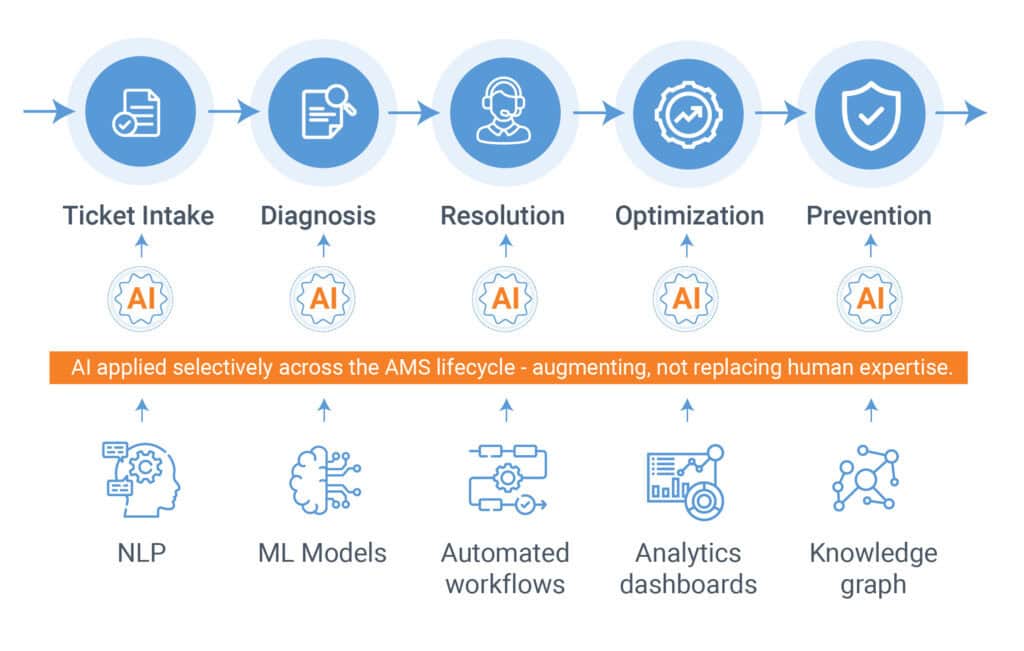
Intelligent Ticket Triage
Natural language processing can be used to interpret the context of incoming support requests, rather than relying solely on keywords or manual categorisation. By analysing historical data and service patterns, AI models can help route tickets to the most appropriate functional or technical teams more quickly, reducing delays and improving prioritisation for business, critical issues.
Proactive Issue Detection
Machine learning can analyse system logs, performance metrics, and historical incidents to identify early warning signs. Instead of waiting for failures, support teams are alerted to emerging risks and can act before disruptions occur, shifting support from reactive to preventative.
Self-Healing Capabilities
Certain recurring, predictable issues can be resolved automatically through predefined workflows. These interventions often occur in the background, restoring services before users are even aware of an issue and freeing consultants to focus on more complex challenges.
Knowledge Institutionalisation
AI systems can help capture, structure, and reuse operational knowledge across the organisation. This reduces dependency on individuals, improves consistency, and strengthens resilience as teams evolve, provided appropriate controls and governance are in place.
Analytics-Driven Optimisation
Advanced analytics can surface trends across large datasets, supporting decisions around performance tuning, capacity planning, and license optimisation. These insights are difficult to achieve through manual analysis alone and enable a more data-driven approach to SAP operations.
This is not automation for its own sake. It is intelligence applied selectively across the AMS lifecycle to support better outcomes.
Measurable Impact
This isn’t theory. Organisations adopting AI, enabled AMS are already seeing substantial improvements:
- Fewer support cases raised year, on, year
- Reduction in hours consumed
- Faster resolution times
- Up to 100% uptime with improved system stability
This isn’t theory. Organisations adopting AI, enabled AMS are already seeing substantial improvements:
Beyond the Hype: Getting AI Right
AI is powerful, but its success in AMS depends on strong foundations and disciplined adoption.
Data quality is critical. Machine learning models are only as effective as the data they are trained on. Inconsistent, incomplete, or poorly governed data limits value and introduces risk.
Change management matters just as much as technology. Support teams must adapt to AI, augmented workflows, learning how to interpret recommendations, validate outcomes, and apply human judgement where needed.
A phased approach is typically the most effective. Starting with targeted use cases, such as monitoring or request categorisation, allows organisations to build confidence, demonstrate value, and scale responsibly.
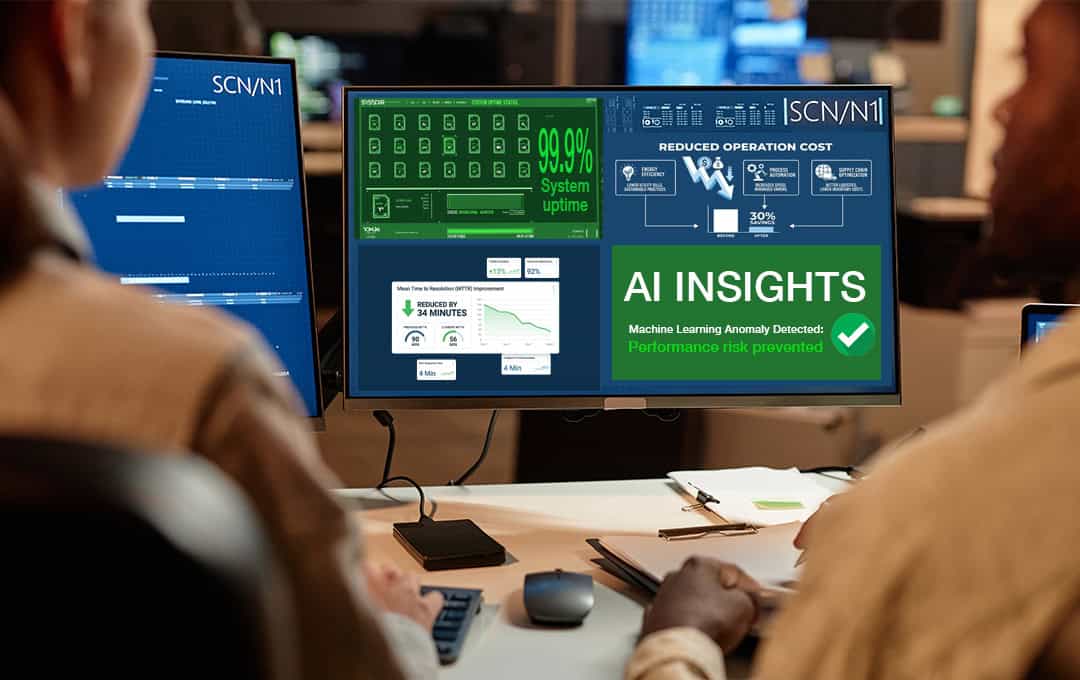
Most importantly, AI works best when paired with human expertise. AI handles diagnostics, pattern recognition, and routine tasks; consultants focus on complex problem, solving, continuous improvement, and strategic initiatives. Together, they form a more resilient and sustainable operating model.
The Road Ahead
The next generation of AI-enabled AMS continues to evolve. Conversational interfaces may enable users to resolve common issues through natural language interactions. Predictive impact analysis could assess the risk of system changes before they are deployed. Advanced forecasting may optimise infrastructure and licensing costs, while continuous compliance monitoring could strengthen governance and reduce regulatory exposure.
Organisations that partner with an AMS provider already investing in AI, enabled models are not just addressing today’s operational challenges; they are preparing for what comes next.
Why Absoft?
As one of the UK’s leading SAP consultancies, now part of Applexus, Absoft brings deep SAP expertise together with modern, flexible AMS delivery models.
We support clients through onsite, offsite, offshore, or hybrid approaches, balancing local insight with global efficiency. As our AMS capabilities evolve, AI plays an increasing role in improving stability, efficiency, and transparency, while experienced consultants remain central to service quality and outcomes.
Final Thoughts
AI is changing the expectations placed on SAP AMS. Reactive support alone is no longer enough. The future lies in proactive, preventative, and business, aligned service models that reduce risk and improve performance.
For business leaders, the question is no longer whether AI has a role in SAP support, but how deliberately and responsibly it can be adopted to strengthen resilience, efficiency, and long, term competitiveness.
To see how AI-enabled AMS can keep your SAP landscape stable, proactive, and cost-efficient, get in touch today.